Follow the Forge:FacebookInstagram
Welding e-book · English edition

Stop burning rods.
Learn to weld right, from the first arc to the shop floor.

A practical welding guide in plain American English, covering the processes you will meet most in the shop and in industry — stick, MIG/MAG and TIG — with reference tables to set your machine without guessing. Straight to the point, made to read on your phone next to the bench.

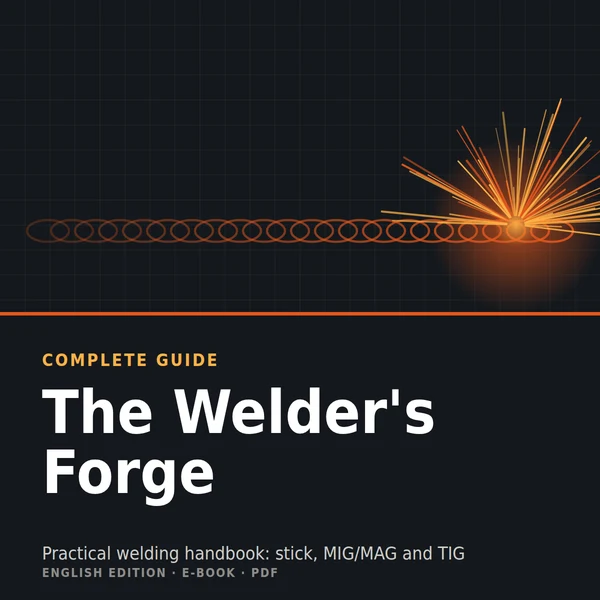
Cover of the e-book The Welder's Forge: a practical welding handbook covering stick, MIG/MAG and TIG
68pages
23reference tables
25technical figures
3main processes

PDF e-book · Access by email through Hotmart · 14-day guarantee

Secure checkout
Secure payment
Processed by Hotmart
Access by email
The link arrives once payment is confirmed
14-day guarantee
Full refund, no reason needed

Payment is processed securely by Hotmart; the payment methods available for your country appear at checkout.

The e-book

One guide, one goal: weld right from the first bead.

Everything you need to set the machine and weld safely, in a single PDF.

Start here
Cover of the e-book The Welder's Forge

The Welder's Forge

Practical welding handbook: stick, MIG/MAG and TIG · English edition

  • Stick (SMAW), MIG/MAG (GMAW) and TIG (GTAW), each with its own chapter
  • 23 reference tables: current by rod diameter, MIG/MAG settings, tungsten, helmet lens shade and more
  • 25 technical figures · 68 pages in PDF
  • Welding at home (auto body, restoration, fabrication), codes and standards, and where welders work
$12.90USDOne-time payment · no subscription · the PDF is yours

Access by email. Hotmart sends the link as soon as your payment is confirmed. If it does not show up, check your spam folder.

Pay securely Payment is processed securely by Hotmart; the payment methods available for your country appear at checkout.

An honest note: this guide gives you the technical base. It is not a promise of a job or any particular result, and it does not replace hands-on training. What you get out of it depends on your practice.

What you will learn

Welding without the fluff: plain theory, practice straight at the bench.

The 3 processes that matter

Stick, MIG/MAG and TIG: when to use each one and how to set it up without guessing. Plus an overview of flux-cored, oxyacetylene, brazing and resistance welding.

23 reference tables

Current by rod diameter, MIG/MAG settings on carbon steel, tungsten for TIG and helmet lens shade, so you stop burning through plate by trial and error.

Defects and inspection

Porosity, lack of fusion, undercut and cracks: how to recognize them, why they happen and a quick bench diagnosis.

Safety, for real

Full PPE, fumes, electricity and fire, with pointers to the rules that cover them, such as ANSI Z49.1, OSHA and NFPA 51B.

Garage and auto body

Thin sheet without burn-through, floor pans and rocker panels, gates and square tubing, and what to check on your 120 V or 240 V power before you plug in the machine.

Standards and pathways

AWS, ASME IX and ISO explained in plain words, how welder performance qualification works, and the usual pathways, such as employer tests, apprenticeships and technical-school programs.

Quick guide

Stick, MIG or TIG: which one should you pick?

The three most-used arc welding processes in a few lines. In the e-book, each one has its own chapter and tables.

Stick welding (SMAW)

The classic "arc welder". The machine is simple and handles wind and outdoor work. Good for structural steel, gates, trailers and repairs. Harder on thin sheet, and it leaves slag to chip off.

MIG/MAG (GMAW)

Continuous wire with shielding gas: MIG with an inert gas (argon, for aluminum), MAG with an active gas (CO₂ or mixes, for carbon steel). Most people say just "MIG" for both. It is the fastest to learn and very common in fabrication and auto body work.

TIG (GTAW)

A non-consumable tungsten electrode with the filler rod in your other hand. The cleanest and most precise, ideal for stainless, aluminum and thin parts, and the most demanding in coordination.

Where to start? For most beginners, MIG or stick. But the right choice depends on the metal, the thickness and where you will work. That is what the guide helps you decide before you turn the machine on.

Look inside

What is inside, chapter by chapter.

An introduction, 17 chapters and a conclusion across 68 pages.

The chapters

• Introduction: how to use this e-book
01 Welding Basics: Processes, Joints and Positions
02 Personal Protective Equipment (PPE)
03 Stick Welding (SMAW)
04 MIG/MAG Welding (GMAW)
05 TIG Welding (GTAW)
06 Flux-Cored Arc Welding (FCAW)
07 Submerged Arc Welding (SAW)
08 Oxyacetylene Welding and Cutting
09 Resistance Welding
10 Brazing and Soldering
11 Basic Metallurgy for Welders
12 Welding Defects and How to Avoid Them
13 Inspection and Quality Control
14 Codes, Standards and Qualification (AWS, ASME, ISO)
15 Welding Safety
16 Welding at Home: Auto Body, Restoration and Fabrication
17 Where Welders Work: Sectors and Qualification Pathways
• Conclusion

One of the 23 tables

Table 3.2 — Recommended current by electrode diameter (flat position)
DiameterCurrent
5/64 in (2.0 mm)45–70 A
3/32 in (2.4 mm)60–90 A
1/8 in (3.2 mm)90–130 A
5/32 in (4.0 mm)130–180 A
"For beginners: start with an E6013 electrode, 1/8 in (3.2 mm), at 90–110 A, in the flat position, on 1/4–5/16 in (6–8 mm) carbon steel plate." Starting points only: confirm with the rod package, the WPS or the machine manual.

68 pages · 23 reference tables · 25 technical figures

📄 Download the free PPE chapter (PDF)

Read a whole chapter before you decide. No sign-up. See what is in the sample

Why trust it

You do not have to take our word for it. Check.

📄 Read before you pay

The PPE chapter is free to download in full. You see the level of the content before you decide.

📐 Imperial first, metric too

Written in plain American English, with inches first and millimeters in parentheses, US filler metal designations and 120/240 V shop power.

🛡️ 14 days to decide

Buy it, use the tables at the bench and, if it is not for you, ask for a full refund. Payment is processed by Hotmart.

Why pay

"Isn't all of this free online?"

It is, scattered across hundreds of videos, with no order and no table to look things up.

Learning from random videos

  • Hours of loose clips with no method or sequence
  • Advice from different countries and codes, all mixed together
  • No ready tables: you write everything down by hand
  • Ads and distractions every few minutes
  • Hard to find one setting quickly at the bench

The Welder's Forge

  • Everything organized, from zero to the shop floor, in one place
  • US designations, with metric in parentheses
  • 23 reference tables ready to look up
  • No fluff: straight to what matters
  • On your phone at the bench: pay once and it is yours
Who it is for

If you are going to pick up a welding machine, it is for you.

If you want to learn a trade

You are starting from zero and want to understand the work before you step into training or a shop: processes, settings, defects, codes and safety. The e-book gives you the technical base so you arrive at hands-on training, and at the first test your employer asks for, knowing what you are doing. It does not replace that training.

If you want to weld in the garage

Auto body repair, classic car restoration, floor pans and rocker panels, gates, trailers and small fixes at home. Independence to do your own projects, save on labor and stop wasting material.

14-day guarantee

Download it, use the tables and, if it is not for you, ask for a full refund within 14 days. No hard questions.

14-day guarantee
Satisfaction or your money back
Secure purchase
Your data is protected at checkout
Protected payment
Processed by Hotmart
Before you decide

Frequently asked questions about learning to weld

Is it an e-book or a video program?
It is a digital e-book in PDF, 68 pages long. You read it on your phone, tablet or computer, and the file is yours to keep. There are no videos and no live sessions.
How do I get it after I pay?
Hotmart sends the access link to your email as soon as the payment is confirmed. Some payment methods confirm faster than others, so if you do not see the email right away, check your spam or promotions folder.
What payment methods can I use?
Payment is processed securely by Hotmart. The payment methods available for your country appear at checkout. The price is in US dollars, and the final amount is shown before you pay.
Why pay $12.90 when there is so much free information online?
Because here it is all organized, from the first arc to the shop floor: 68 pages, 23 reference tables and 25 technical figures. Instead of piecing together scattered videos, you look up the right table at the bench whenever you need it. And you have 14 days to ask for your money back if it is not for you.
Can I learn to weld on my own, at home?
You can learn the technical base: setting the machine, preparing the joint, reading the bead and working safely. Hand skill only comes with practice, and the e-book is built to guide that practice. It does not replace hands-on training. If your goal is to work in industry, pair the reading with supervised, in-person training.
My machine runs on 120 V. Does the e-book cover that?
Yes. The home-shop chapter explains how to read the machine nameplate (input voltage, input current, duty cycle), why the outlet, wiring and breaker must match it, and why long or thin extension cords are a problem. If a breaker keeps tripping, the advice is to call a licensed electrician, never to improvise.
Which process is easiest for a beginner?
For most people, MIG: the wire feeds by itself and you only control the gun. Stick welding uses the simplest machine and works well outdoors. TIG is the most demanding. The e-book shows when to use each one.
What is inside, chapter by chapter?
An introduction, 17 chapters and a conclusion: welding basics, PPE, stick, MIG/MAG, TIG, flux-cored, submerged arc, oxyacetylene, resistance welding, brazing and soldering, basic metallurgy, defects, inspection, codes and standards (AWS, ASME, ISO), welding safety, welding at home, and where welders work.
Are sizes in inches or millimeters?
Both. Imperial comes first and metric follows in parentheses, for example 1/8 in (3.2 mm) or 250 °F (120 °C). Electrical values are simply amps and volts. Filler metals use the US designations, such as E6013, E7018 and ER70S-6.
What if I do not like it?
You have 14 days to ask for a full refund, no reason needed. You make the request through Hotmart or by emailing our support address.
Does this guarantee a job?
No. The e-book gives you the technical base to learn. It is not a promise of a job, a qualification or any particular result: what you get out of it depends on your practice, your training and your situation.

Grab the handbook and go straight to the bench.

Stick, MIG/MAG and TIG, with 23 reference tables to check when you set the machine.

Access by email · 14-day guarantee · Secure payment through Hotmart

Contact us

Any questions before you buy?

Talk to us on WhatsApp or by email. Official support comes from Academy Convert, the producer of the e-book.

Official support on WhatsAppTalk to Academy ConvertQuestions about the e-book, your access or the guaranteeOpen chat

We reply as soon as we can, usually on business days.

Academy ConvertProducer and support: Academy Convert